The Saint: Cedwyn, Confessor
The record
DOCUMENTED The standard reference is Sabine Baring-Gould and John Fisher, The Lives of the British Saints, vol. II (Honourable Society of Cymmrodorion, 1908), p. 98, entry “S. Cedwyn, Confessor”. It records:
Family. “Cedwyn was the son of Gwgon Gwron ab Peredur ab Eliffer Gosgorddfawr, by Madrun, daughter of Gwrthefyr Fendigaid. His mother was at one time also married to Ynyr Gwent, and is reckoned among the Welsh Saints.” His father appears as Gwgawn Gwrawn in the Triads of Arthur and his Warriors (Peniarth MS 45).
Church. “Cedwyn is the patron of Llangedwyn, in Denbighshire.” One of its townships, Scrwgan, “is believed to stand for Esgair Wgan, the Ridge or Hill of Gwgan, embodying his father’s name.”
Poetry. The poet Lewis Glyn Cothi, in the fifteenth century, “invokes Cedwyn in two of his poems”.
A lost church. In the Book of Llandaf, Lann Cetguinn in Ystrad Yw (south-east Breconshire) is among the churches consecrated by Bishop Herwald (d. 1104), “but there do not appear to be any traces of it now”. The Book of Llandaf text bears this out: “consecrauit ecclesiam … lann cetguinn” (Evans & Rhys 1893, p. 279).
Place-names. Cum Cetguinn in the boundary of Wonastow, near Monmouth (Book of Llandaf, p. 202); Nant Cedwyn and Cwm Cedwyn on the Ely between Leckwith and Llandough; and Ynys Cedwyn, whose Cedwyn “is said to have been a giant”.
No feast day is given for Cedwyn in the entry, and no holy well dedicated to him was found in the sources searched for this edition.
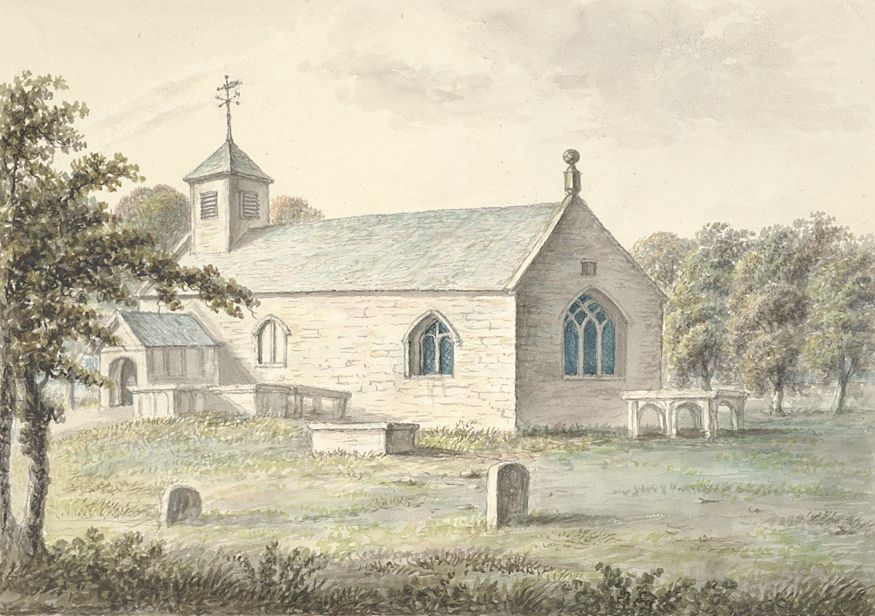
Llangedwyn church, 1795, by John Ingleby. Public domain, via Wikimedia Commons. The church of St Cedwyn at Llangedwyn is a Grade II listed building (Wikipedia, “Llangedwyn”; OS 2nd edition “St. Cedwyn’s Church”, SJ 18860 24129).
The sources behind the pedigree
Baring-Gould and Fisher draw Cedwyn’s pedigree from four places: Peniarth MSS 74 and 75 (sixteenth century), the Myvyrian Archaiology (p. 420) and the Iolo Manuscripts (p. 128).
DOCUMENTED The Iolo Manuscripts (Welsh MSS Society, 1848) give: “Cedwyn, the son of Gwron Meigwron, the son of Peredur, the son of Eliver Gosgorddvawr; and Madryn, the daughter of Vortimer the Blessed was his mother.”
Caution on Iolo Morganwg. The Iolo Manuscripts were drawn from the papers of Edward Williams, “Iolo Morganwg” (1747–1826). The Dictionary of Welsh Biography records that he included “many of his forgeries (or inventions)” in his publications, among them the Myvyrian Archaiology (1801–07). Material that reaches us only through Iolo, or through the Myvyrian Archaiology, is therefore possibly forged and should be checked against earlier manuscripts. For Cedwyn, the sixteenth-century Peniarth MSS 74 and 75 predate Iolo and carry the same pedigree, so the outline of the pedigree does not rest on Iolo alone.
Saint, giant and farm
INFERENCE Three figures share one name: Cedwyn the saint of Llangedwyn, Cedwyn Gawr the giant of Ynys Cedwyn, and the Cedwyn of Cwm Cedwyn on the Ely. Baring-Gould and Fisher keep the giant apart from the saint. Nothing found for this edition makes the saint a patron of Llandough (the church there is St Dochdwy’s) or ties him to the farm, beyond the name of the dell beside it. Whether Cwm Cedwyn recalls the saint, a local man of that name, or neither (see the cydffin reading in The Names) is open.